Purchasing Cost
Definition
The purchasing cost is the amount paid per inventory unit, multiplied by the quantity purchased. If its constant unit price is and all demand is met at constant rate , the long-run purchasing cost rate is .
Interpretation
Purchasing cost is the money paid for the goods themselves, not the fixed charge per order or the cost of keeping stock. If all demand is met, on average units are bought per unit of time whatever the batch size, so a constant unit price gives the rate for every EOQ policy.
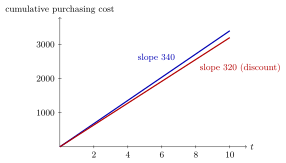
The lines show cumulative cost at the long-run average purchasing rate, with phones per day: slope at the price , slope at the discounted price . Actual batch payments form a staircase, jumping at purchase times; these straight lines smooth those payments to compare average rates. Batch size determines the payment times and which unit price applies, but not the rate at a fixed price.
A constant can therefore be left out when choosing the classical EOQ. With quantity discounts the unit price depends on the batch size , and then must be compared together with setup and holding costs.
Key Results
- A constant can be omitted when finding the classical EOQ, but retained when reporting full costs.
- All-unit price breaks require comparing purchasing cost as well as setup and holding costs.
- Purchasing cost is different from the fixed cost of initiating an order.
Examples
- In the figure, time is measured in days. At demand phones per day and unit price , the smoothed cumulative cost has slope per day.
- A discounted unit price of 160 reduces that rate to 320 when the order qualifies.
Prerequisites
Related Concepts
Sources
- OR Modelling · Week 5
Aliases: purchase cost, procurement cost
Last updated: 27 October 2026 11:52
Purchasing CostEOQ with Price BreaksInventory PolicySetup Cost