Uniform Demand Distribution
Definition
The course's uniform demand model assumes is uniformly distributed on a known interval , with . Its CDF inside the interval is , with values 0 below and 1 above . Thus the continuous newsvendor quantity is
Interpretation
Uniform demand says that every demand level in is equally likely: only the range is known. The probability that demand is at most then grows in proportion to , so the critical quantile is found by a linear interpolation between the two endpoints.
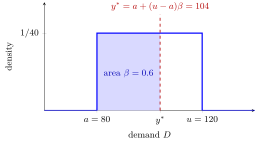
The density is flat at height between and , so the shaded rectangle from to has area , which is . Setting this equal to gives width and : the order lies of the way from to .
In , the lower endpoint is demand that is certain to occur, is the uncertain part, and the critical ratio is the fraction of the uncertain part worth covering. With the order is the midpoint; with near it is close to , and with near close to . Since , the order always lies inside , so the continuous newsvendor rule needs no boundary case here.
A common slip is to compute instead of . For the meals this gives , below the smallest possible demand; the two formulas agree only when .
Key Results
- The distribution is used as an application of probability prerequisites; the course does not develop a general distribution theory.
- For , the quantity is the midpoint.
- The quantile lies within the demand interval.
Examples
- For meal demand on and , order 104.
- For that same interval, and .
Prerequisites
- Continuous Newsvendor Rule
- Uniform distribution
Related Concepts
Sources
- OR Modelling · Week 6
Aliases: uniform demand model Symbols: beta
Last updated: 20 October 2026 03:02
Uniform Demand DistributionContinuous Newsvendor RuleNormal Demand Distribution