Contingent Decisions
Definition
Contingent decisions are binary choices whose admissibility depends on other choices. If decision 2 is allowed only when decision 1 is yes, the implication is represented by
Interpretation
Contingent decisions model the logical rule "decision 2 is only possible if decision 1 is taken", such as building a warehouse only where a factory is built. With binary variables for the two yes-or-no choices, the rule becomes the linear inequality .
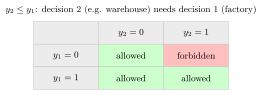
The table lists all four value pairs of . Three of them satisfy ; only , fails, since is false. That is exactly the forbidden combination, decision 2 without decision 1. The pair , stays allowed, so the inequality does not force decision 2 once decision 1 is taken.
Checking every value combination, as in the table, is the general way to design and verify such constraints. In words, says "if then ", or equivalently "if then ". If instead decision 2 must be taken whenever decision 1 is, the reverse inequality is needed, and requiring both gives .
A common slip is to read as a two-way link. It only rules out "2 without 1"; whether decision 2 is taken when decision 1 is depends on the objective and the other constraints. Rules with several conditions are built from several such inequalities, one per condition, as in the Key Results. Mutually exclusive decisions express a different rule, "at most one", with a sum. Both kinds of rule can be added to a project selection model when projects depend on or exclude each other.
Key Results
- If decision 2 must be yes when decision 1 is no, use .
- If decision 3 is allowed only when both decisions 1 and 2 are yes, use and .
- If and must imply , use .
Examples
- With binaries if a warehouse is built at location LA and if a factory is built there, requires a local factory before a warehouse can be built.
- rules out all three yes decisions together.
Prerequisites
Related Concepts
Sources
- OR Modelling · Week 3
Symbols: element of
Last updated: 20 October 2026 03:02
Contingent DecisionsBinary VariableMutually Exclusive DecisionsCapacity Expansion Model