Decision Variable
Definition
A decision variable represents a quantity or choice that the model is intended to determine. Its definition specifies its practical meaning, unit, and allowed values. A solution assigns a value to every decision variable.
Interpretation
A clear variable definition connects a mathematical expression to a real decision. It also determines whether fractions, negative values, or only yes-or-no choices make sense.
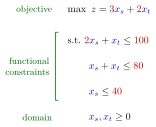
The objective function is the quantity to maximize (for example, profit) or minimize (for example, cost). Functional constraints describe what an allowed decision must satisfy, such as resource limits or demand requirements. Domain restrictions specify signs or integrality.
In the diagram, blue identifies decision variables, whose values the model determines; red identifies model parameters, the given data , and . In general, the model is subject to , where the constraints define the feasible set . A solution assigns values to all variables.
Key Results
- The number of decision variables is the dimension of the original optimization problem.
- Input data such as available hours are parameters rather than decisions.
- Variable restrictions must be stated explicitly.
Examples
- denotes the number of wooden soldiers to produce in the Giapetto production model.
- denotes pounds of feed A in a pig diet problem.
Prerequisites
- No additional prerequisites.
Related Concepts
Sources
- OR Modelling · Week 1
Aliases: choice variable Symbols: element of
Last updated: 20 October 2026 03:02
Decision VariableBinary VariableConstraintLinear Program FormulationNonnegativity ConstraintObjective FunctionModel Parameter