Overage Cost
Definition
The overage cost in the newsvendor model is the net loss on one unit ordered but not sold at its regular price:
where is its unit cost and its salvage value. Total expected overage cost at order quantity is .
Interpretation
The overage cost is what one unsold unit costs in the end: it was bought for and brings back only the salvage value , so the net loss is . It is the price of ordering one unit too many.
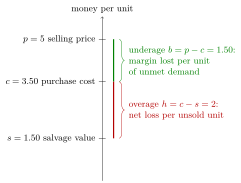
The money scale shows the newspaper data: the purchase cost and the salvage value are apart, the lower gap. The upper gap, from to the selling price , is the underage cost ; together they span , the denominator of the critical ratio .
Only leftover units are charged, and the positive part counts them. A higher salvage value lowers and raises the optimal order; a negative , a disposal fee, makes larger than . Unlike the EOQ holding cost, which is charged per unit per unit of time, is charged once per leftover unit of the single period.
Key Results
- Only leftover units incur overage loss.
- Increasing salvage value lowers overage cost.
- This is a single-period per-unit loss, whereas EOQ holding cost is charged per unit per unit time.
Examples
The illustrated newspaper data give overage cost and underage cost , hence critical ratio . These are single-period per-unit losses, rather than EOQ cost rates.
- Newspapers costing 3.50 and salvaged for 1.50 have .
- Meals costing 2.20 with zero salvage have .
Prerequisites
Related Concepts
Sources
- OR Modelling · Week 6
Aliases: overstocking cost, overstock cost Symbols: beta
Last updated: 20 October 2026 03:02
Overage CostCritical RatioNewsvendor ModelPositive PartUnderage Cost