Bus Scheduling Model
Definition
The bus scheduling model chooses nonnegative integer counts of buses starting in each of six consecutive four-hour intervals. Each bus operates for two intervals. With requirements , the cyclic model is
where .
Interpretation
The model finds the smallest fleet of buses that meets the requirement in every four-hour interval when each bus works two consecutive intervals. The variables count shift starts, while each coverage constraint counts all buses operating in an interval.
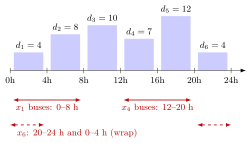
The bars show the requirements and the arrows show shifts. The buses run from 0 to 8 h and serve intervals 1 and 2, and the buses serve intervals 4 and 5. The buses start at 20 h, serve interval 6 and then, after midnight, interval 1 of the next day. Interval 1 is therefore covered by , which is why the model sets .
Each variable appears in exactly two constraints, those of its starting interval and the next one. Adding all six constraints gives , so at least 23 buses are needed. This bound is not attained: enumerating the integer solutions gives a minimum of 26, so the optimal plan covers some intervals with more buses than they require.
Linear program formulation turns shift counts into decision variables and requirements into linear inequalities. Because every variable counts buses, the model is a pure integer program. The ambulance location model has the same coverage structure with yes-or-no variables.
A common slip is to write , reading as the number of buses on duty in interval . That ignores the buses that started one interval earlier and asks for more buses than necessary.
Key Results
- Eight-hour operation covers exactly two consecutive four-hour intervals.
- Coverage may exceed the minimum demand.
- The repeating daily interpretation is the assumption used to formulate the midnight boundary.
Examples
- The midnight-to-4 AM constraint is .
- The 4 PM-to-8 PM requirement gives .
Prerequisites
Related Concepts
Sources
- OR Modelling · Week 2
Keywords: Shift scheduling Symbols: element of, integers, sum
Last updated: 20 October 2026 03:02
Bus Scheduling ModelPure Integer ProgramLinear Program FormulationAmbulance Location Model