Objective Function
Definition
The objective function assigns a numerical value to a decision vector. The model specifies whether this value should be maximized or minimized. In an LP it has the form
where the are given objective coefficients.
Interpretation
The objective expresses the criterion used to compare feasible choices. Profit maximization and cost minimization are common, but the course also considers distance, time, and flow.
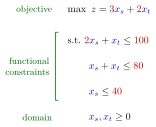
The objective function is the quantity to maximize (for example, profit) or minimize (for example, cost). Functional constraints describe what an allowed decision must satisfy, such as resource limits or demand requirements. Domain restrictions specify signs or integrality.
In the diagram, blue identifies decision variables, whose values the model determines; red identifies model parameters, the given data , and . In general, the model is subject to , where the constraints define the feasible set . A solution assigns values to all variables.
Key Results
- An objective value is a number; an optimal solution is a vector of decisions.
- In a profit objective, use revenues minus relevant costs.
- The direction of optimization determines what constitutes an improvement.
Examples
Prerequisites
Related Concepts
Sources
- OR Modelling · Week 1
Symbols: element of
Last updated: 20 October 2026 03:02
Objective FunctionLinear ProgrammingMinimization-to-Maximization TransformationModel ParameterObjective Coefficient RangeObjective LineOptimal SolutionDecision Variable