Feasible Solution
Definition
A feasible solution assigns values to all decision variables and satisfies every constraint, including their domain restrictions. A solution violating at least one constraint is infeasible.
Interpretation
Feasibility asks whether a decision is allowed, independently of how good it is. A decision is feasible when it satisfies every constraint of the model, including the restrictions on the values of the variables.
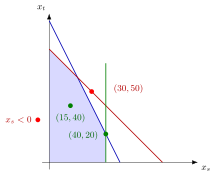
The green points and are feasible; lies on two boundary lines, which is allowed because the constraints are . The red point fails a single constraint, finishing time, and is therefore infeasible, as is any point with .
All constraints must hold together: one violated inequality is enough to reject a decision, and a large surplus in one constraint does not make up for a violation in another. In the figure, would give Giapetto a profit of , more than the best feasible profit , but it needs finishing hours where only are available.
The feasible solutions together form the feasible region, and an optimal solution is a feasible solution with the best objective value. A feasible solution without a proof of optimality, for example one found by a heuristic, can still be carried out, and its objective value bounds the optimum.
A common slip is to treat a boundary point as infeasible. Constraints with or include equality, so a plan that uses a resource exactly is feasible.
Key Results
- An attractive objective value does not compensate for a violated constraint.
- An LP-feasible fractional solution may be infeasible after integer restrictions are imposed.
- Every optimal solution is feasible.
Examples
In the figure, satisfies , and ; is also feasible. By contrast, requires finishing hours, and any violates nonnegativity.
- For , , , , is feasible.
- In the same model, is infeasible because .
Prerequisites
Related Concepts
Sources
- OR Modelling · Week 1
Aliases: feasible point
Last updated: 20 October 2026 03:02
Feasible SolutionBasic Feasible SolutionBin Packing ProblemFeasible RegionHeuristicIncumbent SolutionOptimal SolutionConstraint