Euler Network Characterization
Proposition
A finite connected undirected network has an Euler tour if and only if every vertex has even degree. Such a network is called an Euler network.
Interpretation
The proposition replaces a search over all possible routes by a check done vertex by vertex: in a connected network, a closed route using every edge exactly once exists exactly when all degrees are even.
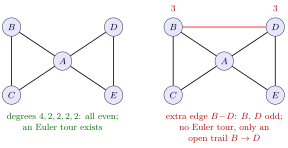
In the left network the degrees are , all even, and an Euler tour exists. The right network adds the edge , which raises the degrees of and to . Now no Euler tour exists, but a route that starts at , ends at and uses every edge once still does.
Even degree is necessary because a closed route pairs every arrival at a vertex with a departure; at the starting vertex, the first departure pairs with the final arrival. So the route uses the edges at each vertex two at a time. Sufficiency is the harder direction, and the cycle-splicing construction of the Euler tour algorithm establishes it. Connectedness cannot be dropped: two separate triangles have all degrees equal to 2, yet no single route covers both.
With exactly two odd vertices, as on the right, a connected network still has an open route between them that uses every edge once; the Königsberg network, with four odd vertices, has neither kind of route. The Chinese postman problem makes odd degrees even by duplicating paths, after which the proposition applies.
Key Results
- One odd-degree vertex is enough to rule out an Euler tour.
- Connectedness of the edges is required to traverse all edges in one tour: if the edges lie in two or more separate parts, no single tour covers them all (isolated vertices do no harm).
- Parallel copies introduced by the Chinese postman construction are counted as separate edges.
Examples
- The seven-bridge network violates the even-degree condition.
- Duplicating suitable paths between odd-degree vertices makes their endpoint degrees even.
Prerequisites
Related Concepts
Sources
- OR Modelling · Week 4
Last updated: 27 October 2026 11:52
Euler Network CharacterizationEuler Tour AlgorithmConnected NetworkEuler TourVertex DegreeChinese Postman Problem