Degeneracy
Definition
A degenerate basic feasible solution has at least one basic variable equal to zero. A degenerate pivot has a zero step length (the minimum-ratio test gives , so the entering variable stays at zero) and can change the basis without changing the solution vector or objective value.
Interpretation
Degeneracy happens when a corner of the feasible region lies on more constraint lines than are needed to fix it. In two variables two lines suffice; when a third passes through the same point, more variables are zero there than a basic solution sets to zero, so some basic variable takes the value .
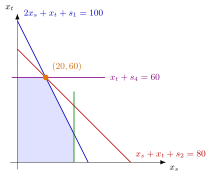
At the lines , and meet, so . The augmented form has six variables and four equations, so only two variables are nonbasic and at least one of the three zero slacks is basic. Any two of can be the nonbasic pair, and each choice gives the same point: one corner, three bases.
In the simplex method, degeneracy shows up in the minimum-ratio test. A tie means that two basic variables reach zero at the same moment; only one leaves, and the other stays basic with value . If a later ratio test gives , the pivot exchanges variables without moving: the point and stay the same.
Being basic is a matter of the chosen basis, not of the value, so a basic variable can be zero. At a degenerate corner the optimality test can even show a negative coefficient although the point is optimal; further degenerate pivots can then reach a basis that passes the test. The real risk is cycling, described in the Examples.
Key Results
- A tie for the minimum ratio can produce a degenerate basic feasible solution.
- Zero ratios must be considered when the pivot-column coefficient is positive.
- The basic/nonbasic distinction is determined by the basis, not by whether a value is zero.
Examples
At the illustrated point , . The augmented model has two nonbasic variables, so at least one of these three zeros is basic. Without an anti-cycling rule (a tie-breaking rule for the entering and leaving variables, such as Bland's smallest-index rule), repeated degenerate pivots can cause simplex to cycle, that is, return to an earlier basis and repeat indefinitely.
- With and , increasing gives tied ratios of 1.
- At , exchanging for leaves the point and the objective value unchanged.
Prerequisites
Related Concepts
Sources
- OR Modelling · Week 3
Aliases: degenerate basic feasible solution Symbols: theta
Last updated: 27 October 2026 11:52
DegeneracyBasic VariableMinimum-Ratio TestSimplex PivotMultiple Optimal SolutionsSimplex Optimality Test