Network
Definition
A network consists of a set of vertices and edges connecting specified pairs of vertices. Vertices represent entities or locations; edges represent connections. Depending on the problem, edges may have directions and numerical values such as distances, costs, or capacities.
Interpretation
A network separates the connection structure of a problem from its physical setting: it records only which pairs of objects are joined and, where needed, a number on each connection. The same representation can describe roads between cities, cables between sites or the order of project activities.
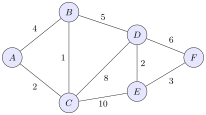
The figure has six vertices and nine edges, each labelled with its length; only these numbers count, not the lengths on paper.
Edges may be usable in both directions, as in an undirected network, or in one direction only, as in a directed network. An edge value is read in the problem's own units: a distance is added up along a path, while a capacity limits how much can pass through a single edge.
Key Results
- Vertices are also commonly called nodes.
- An edge may be used only in its specified direction in a directed network.
- The meaning of an edge value depends on the problem: distance and capacity are different quantities.
Examples
The figure has vertices and edge labels denoting lengths.
- A road network connects cities by roads.
- A project network represents activities and their precedence relations.
Prerequisites
- No additional prerequisites.
Related Concepts
Sources
- OR Modelling · Week 4
Keywords: graph
Last updated: 20 October 2026 03:02
NetworkBipartite MatchingDirected NetworkKönigsberg Bridge ProblemPath in a NetworkUndirected NetworkVertex Degree