Nonconvex Region Modelling
Definition
Nonconvex region modelling represents a union of allowed regions using binary variables that select which region's inequalities are enforced. The selected region must satisfy all its defining inequalities; common constraints remain active for every selection.
Interpretation
Some models allow decisions in one of several separate pieces, but not in between. A single system of linear inequalities cannot describe such a region exactly: if two points satisfy a linear inequality, so does every point on the segment between them, so a gap can never be cut out. Binary switches make it possible by enforcing the inequalities of one piece at a time.
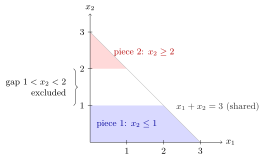
The two pieces share and but differ in one inequality: below and above. The points and are both allowed, while their midpoint lies in the excluded gap . This is what nonconvex means: a segment between allowed points leaves the region.
In the model of the Examples, selects the piece, each inequality that belongs to only one piece receives a big- term as in either-or constraints, and the shared restrictions stay outside the switches so that they hold for both choices. With more than two pieces, one indicator per piece and an exactly-one constraint do the selection.
The size of matters. If it is too small, a switched-off inequality still cuts off allowed points: with and , the second inequality becomes , which together with leaves only the points of the lower piece with . A much larger than needed is valid but enlarges the region of the LP relaxation, so its bound can only become weaker.
Key Results
- Use one indicator per region and require exactly one selected region. With only two regions a single binary suffices: and act as the two indicators.
- Relax every inequality belonging only to an unselected region with a valid big- constant, as in either-or constraints: must be large enough that the relaxed inequality cuts off no point the model allows.
- Keep nonnegativity and shared boundaries outside the switches.
Examples
The illustrated region, the course video example, is , , with either or . Its switch is , , . With the lower piece is enforced and the second inequality becomes ; with the upper piece is enforced and the first becomes . Because on the shared region, is already large enough. The common restrictions and remain active for both choices.
- The practice region additionally selects , , or under .
Prerequisites
Related Concepts
Sources
- OR Modelling · Week 3
Symbols: element of
Last updated: 20 October 2026 03:02
Nonconvex Region ModellingFeasible RegionEither-Or ConstraintsMutually Exclusive DecisionsMixed Integer Program