Price-Break Indifference Quantity
Proposition
Let and , with . The price-break indifference quantity solves
or equivalently
Interpretation
The indifference quantity answers how far above the EOQ a price-break threshold may lie and still be worth reaching. Up to , the purchasing discount on every unit outweighs the extra setup and holding costs of the larger batch; beyond it does not.
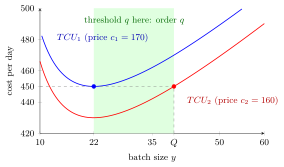
The horizontal line at is the best cost without discount, . The discounted curve lies below it from up to , where it climbs back to . A threshold in the shaded band, such as , should be reached; a threshold beyond should not.
At the discount saves per day. Moving the batch from to raises setup and holding cost from to per day, which uses up exactly that saving. Multiplying by gives the quadratic equation of the Proposition. It has two solutions, for the phones about and ; the smaller one lies below , and a threshold below needs no comparison, since itself then qualifies for the discount. Only the larger solution is a useful boundary.
is not an optimal order quantity itself: it is a boundary for the threshold . In practice it is enough to compare the full costs of the two candidates and , as in EOQ with price breaks; shows at once which thresholds are worth reaching.
Key Results
- With the worked-example convention that qualifies, a threshold favours ordering .
- For , retain ; for , already receives the discount.
- At , the two candidates tie.
- Directly comparing candidate costs avoids solving for .
Examples
- The snack-bar exercise gives kilograms; its threshold 100 is too high.
- For the phone example, , and threshold 35 lies between and .
Prerequisites
Related Concepts
Sources
- OR Modelling · Week 5
Symbols: square root
Last updated: 22 October 2026 19:04
Price-Break Indifference QuantityEOQ with Price BreaksEconomic Order Quantity