Diet Problem
Definition
The course's diet problem chooses pounds of two feeds to minimize daily feed cost while satisfying calorie, vitamin, and composition requirements:
Interpretation
The diet problem is a minimum-cost mixture model: choose amounts of the ingredients so that the mixture meets every requirement as cheaply as possible. Where the Giapetto model caps the use of resources with constraints, the diet problem sets minimum requirements with constraints.
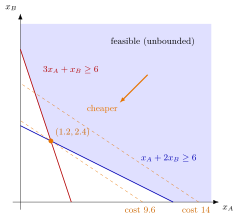
The figure uses the simplified model from the Examples. Both requirements keep the feasible points on or above their lines, so the feasible region is unbounded upwards and to the right. The dashed cost lines become cheaper towards the origin, and the cheapest one that still meets the region touches it at the corner , with cost .
The unbounded region causes no difficulty for minimization. Both feeds have a positive price and the amounts are nonnegative, so the cost never falls below zero, and moving the cost line towards the origin eventually leaves the region. Maximizing cost over the same region would have no optimum.
The composition restriction shows how a share requirement becomes linear. "At most one third of the feed is A" reads ; multiplying by and collecting terms gives . The fraction form is not linear and is undefined when no feed is bought, so in linear program formulation the multiplied-out form is the one to use.
Key Results
- The share constraint follows from .
- Nutrient requirements are lower bounds, so their inequalities point toward greater nutrient intake.
- The optimal solution is , , with cost .
Examples
The figure uses a simplified illustrative diet model, distinct from the course-data formulation above: minimize subject to , and . The variables still represent pounds of feeds A and B. Sliding the cost line towards the origin gives the illustrated optimum with cost 9.6.
- The optimal mixture contains exactly one-third feed A.
- At the course-data optimum the calorie requirement is tight, while vitamin intake is .
Prerequisites
Related Concepts
Sources
- OR Modelling · Week 1
Keywords: Feeding pigs
Last updated: 27 October 2026 11:52
Diet ProblemLinear Program FormulationGraphical MethodGiapetto Production Model