Production-Inventory Model
Definition
A production-inventory model chooses production and end-of-period stock to meet known demands across periods. With given initial stock , unit production costs , and end-of-period holding costs , the course problem is represented by
Interpretation
The model decides when to produce, not only how much. Production in a cheaper month may be stored for a later month at a holding cost, and the inventory balance ensures that every unit sold comes from current production or previously held stock.
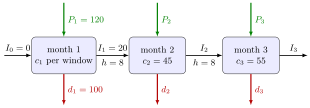
Each month in the figure is a balance: stock arriving from the previous month plus production equals demand plus stock carried out. In month 1, and meet and leave , which is carried into month 2 at a cost of 8 per window.
The balance is what links the months: without it each month would be a separate problem. The nonnegativity of excludes shortages, so demand must be met on time. The objective then weighs producing early against producing late: a month-3 window made in month 2 costs , less than the 55 it costs in month 3, so producing early pays whenever the earlier unit cost plus the holding costs is lower, as long as capacity allows.
Linear program formulation introduces production and inventory decisions, balance equations and capacity restrictions; with continuous and the model is an LP. The same balance returns in the dynamic lot-size model, where every order also carries a fixed setup cost.
Key Results
- Nonnegative inventory rules out shortages.
- The window example charges a holding cost of 8 per window per month on end-of-month inventory.
- The six-month exercise does not specify initial stock; taking is an explicit modelling assumption.
- With positive production and holding costs, no required final stock and no minimum-production constraints, extra production solely to leave unused final stock is unnecessary. Excess initial stock can nevertheless force positive final inventory when disposal is not allowed.
Examples
- Month 1 requires 100 windows; producing 120 from zero stock leaves 20.
- Producing a month-3 window in month 2 costs 45 plus 8 holding, compared with 55 in month 3.
Prerequisites
Related Concepts
Sources
- OR Modelling · Week 2
Symbols: sum
Last updated: 27 October 2026 11:52
Production-Inventory ModelDynamic Lot-Size ModelLinear Program FormulationHolding Cost