Artificial Variable
Definition
An artificial variable is introduced temporarily into an equality or a converted constraint to construct an initial basis. It is added with coefficient and initially takes the nonnegative right-hand-side value while the other variables in that row are zero.
Interpretation
An artificial variable is a temporary device for starting the simplex method. It gives a constraint row a ready starting value when neither a slack nor a surplus variable can provide one. It has no practical interpretation and must be driven to zero before the original equations hold.
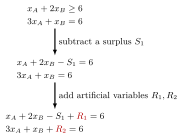
The figure shows why the surplus alone is not enough. After subtracting , setting in the first row would give , which violates , and the equation has no added variable at all. Adding and with coefficient gives both rows a nonnegative starting value.
With , the current augmented row gives , so the current values do not solve the original surplus-variable equality. This does not by itself show that the decision variables violate the original inequality: a smaller surplus might restore that equality. Setting every artificial variable to zero recovers the original augmented system. Phase I of the two-phase method therefore minimizes their sum; a positive minimum shows that no such representation exists and the original problem is infeasible. A row with a nonnegative right-hand side needs no artificial variable, because its slack already starts at the right-hand side.
Unlike a slack or surplus, which measures a real amount and may stay positive in the final solution, an artificial variable has no meaning in the original model. It is set to zero when representing a solution of that model.
Key Results
- They differ from slack and surplus variables, which record genuine inequalities.
- The first phase of the two-phase method maximizes the negative sum of artificial variables.
- The original constraints are recovered when every artificial variable is zero.
Examples
In the figure, setting gives the initial artificial basis . Minimizing is equivalent to maximizing its negative, as used in Phase I.
- becomes .
- becomes .
Prerequisites
Related Concepts
Sources
- OR Modelling · Week 2
Last updated: 27 October 2026 11:52
Artificial VariableTwo-Phase MethodAugmented FormSurplus VariableInfeasible Linear Program