Distribution
Definition
Let be a random variable on a probability space : a sample space , a collection of events, and a probability function on . The distribution of is the probability measure on defined by assigning to each suitable set the probability
Interpretation
The distribution of records where the probability of lies on the real line: for every set of values it gives the probability that lands in . It forgets the sample space and keeps only what can be said about the values of .
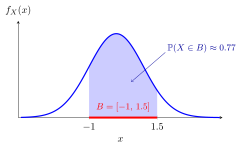
In the figure probability is spread continuously along the line, and for the interval the probability is the shaded area under the curve; the whole area under the curve is . Such a curve is called a density.
Read as the probability of the generated event : the distribution carries the probabilities from over to sets of real numbers. It is again a probability assignment, now on sets of values: all probabilities are nonnegative, , and probabilities of disjoint sets add.
In practice a distribution is not written out set by set. A discrete random variable is described by its PMF, the probability of each single value, and every real random variable by its CDF , which already determines all probabilities . Named families such as the Bernoulli and binomial distributions are distributions in this sense.
Having the same distribution is weaker than being equal. For one fair coin toss, the indicator of heads and the indicator of tails both take the values and with probability each, yet they never take the same value.
Key Results
- The distribution of a real-valued random variable is uniquely determined by its CDF.
- Different random variables can have the same distribution.
- Discrete, continuous, and mixed distributions describe different ways probability can be allocated.
Examples
- Two independent fair coin indicators have the same Bernoulli distribution but are not the same random variable.
- The distribution of a delivery time describes the probabilities of different time intervals.
- A mixture of customer types can create a distribution with several peaks.
Prerequisites
Related Concepts
Sources
- Probability Theory for EOR · Week 3
Aliases: probability distribution, law of a random variable Symbols: element of, omega, real numbers
Last updated: 20 October 2026 03:02
DistributionAbsolutely Continuous DistributionCumulative Distribution FunctionIndependent and Identically Distributed Random VariablesIndependent Random VariablesMixture DistributionPoint MassSummary Measures of a DistributionSupport of a Random VariableSymmetric DistributionUnimodal and Multimodal DistributionMixed StrategyRandom VariableProbability FunctionProbability Mass FunctionProbability Density FunctionConditional Expectation Given an EventExpectation