Standard Normal Distribution
Definition
A random variable has the standard normal distribution, written , if its density is ; its CDF is :
In the second parameter is the variance.
Interpretation
The standard normal distribution is the single reference bell curve, centred at with variance . Every normal probability can be read from its CDF , because any normal variable becomes standard normal after standardization: a value is then measured in standard deviations from the mean.
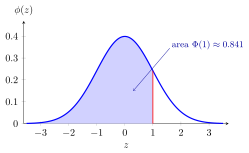
The shaded area is everything to the left of , that is , the first Example. The unshaded right tail has area . Since is symmetric about , the left tail below has the same area, so and .
The density has no antiderivative in terms of elementary functions, so is evaluated numerically, by a table or software. A table for suffices: symmetry gives , and interval probabilities are differences . The value suggested in the manipulate prompt satisfies , so .
For , the variable is standard normal, so ; the second Example uses this with and . A common slip is to divide by the variance: in the second parameter is , so the divisor is . Later, sums of many independent variables are approximated by this distribution after standardization, in the central limit theorem.
Key Results
- , , and .
- If with , then .
- Quantiles transform the same way: the -quantile of is . Printed normal tables list the left-tail probabilities , so a quantile is read off the table in reverse and then transformed back.
Examples
- .
- For , .
Prerequisites
Related Concepts
- Cumulative Distribution Function
- Standardization
- Location and Scale Property of the MGF
- Normal Approximation to the Binomial
Sources
- Probability Theory for EOR · Week 5
- Probability Distributions · supporting concept
- OR Modelling · Week 6
Aliases: N(0,1), standard Gaussian, standard normal, unit normal distribution, standard normal random variable, standard Gaussian distribution Symbols: infinity, integral, mu, phi, pi, sigma, square root
Last updated: 22 October 2026 19:04
Standard Normal DistributionCentral Limit TheoremContinuity CorrectionNormal DistributionCumulative Distribution FunctionStandardizationLocation and Scale Property of the MGFNormal Approximation to the Binomial