Lognormal Distribution
Definition
Let be normally distributed with mean and variance . The random variable has a lognormal distribution with parameters and .
Interpretation
A lognormal variable is a positive quantity whose logarithm is normal. It suits quantities that change by percentages rather than by fixed amounts, such as prices or incomes: a multiplicative change in is an additive change in .
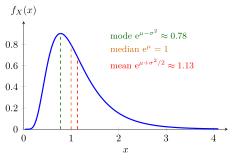
The figure shows with . All probability lies on , and the density has a long right tail. The three dashed lines are, from left to right, the mode , the median and the mean , the usual order for a right-skewed density.
Because the exponential function is strictly increasing, if and only if . Hence, for ,
and every lognormal probability is a standard normal probability. Quantiles carry over in the same way, which is why the median of is : the median of is . The density itself follows from the transformation formula with .
The mean does not carry over like this: is larger than . The parameters and are the mean and variance of , not of .
Key Results
- A lognormal random variable is always positive.
- If is lognormal, then is normal.
- Lognormal models often arise from products of many positive random factors.
Examples
- Household income is often modelled with a lognormal-type distribution.
- Multiplicative investment growth can lead to lognormal returns over time.
- Repair times that are positive and right-skewed may be approximated by a lognormal model.
Prerequisites
Related Concepts
Sources
- Probability Theory for EOR · Week 6
Aliases: log-normal distribution Keywords: exponentiated normal distribution Symbols: mu, phi, sigma
Last updated: 20 October 2026 03:02
Lognormal DistributionNormal DistributionExponential FunctionTransformation of a Continuous Random VariableFunction of a Random Variable