Folded Normal Distribution
Definition
Let be a normally distributed random variable. The random variable has a folded normal distribution.
Interpretation
A folded normal distribution is obtained by reflecting negative normal values to the positive side. It is useful when only the magnitude of a normally distributed quantity matters.
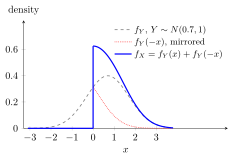
The illustrated calculation gives . The sign is lost, so the density of on the negative side is folded onto the positive side and all mass lands on .
The normal distribution supplies the original variable . Folding by absolute value combines the probability near a positive value with the probability near its negative, giving a nonnegative transformed variable.
Key Results
- A folded normal variable is the absolute value of a normal variable.
- Its support is nonnegative.
- When the underlying normal mean is zero, it is called a half-normal distribution: then has density for .
Examples
- The absolute measurement error from a normally distributed error has a folded normal distribution.
- The distance from zero of a one-dimensional normal displacement is folded normal.
- Quality-control deviations recorded only by magnitude can follow a folded normal model.
Prerequisites
Related Concepts
Sources
- Probability Theory for EOR · Week 5
Aliases: folded Gaussian distribution Keywords: distribution of the absolute value of a normal random variable Symbols: infinity
Last updated: 20 October 2026 03:02
Folded Normal DistributionNormal DistributionAbsolute ValueTransformation of a Continuous Random VariableFunction of a Random Variable