Discrete Uniform Distribution
Definition
Let be a nonempty finite set of distinct real values. A variable is discrete uniform on if for each and its PMF is zero outside .
The course's integer-range case has , where are integers, and
The mean and variance formulas below apply to this consecutive-integer case; for an arbitrary finite set, average its listed values and squared deviations.
Interpretation
A discrete uniform variable picks one value from a finite set, with every value equally likely. It is the random-variable form of naive probability, as for a fair die or a random integer from a range.
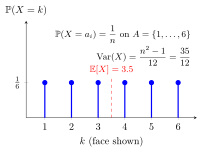
The figure shows a fair die, : six bars of equal height . The dashed line at marks the mean from the Key Results; it lies at the centre because the bars are placed symmetrically, and it is not itself a possible value. The variance in the figure is the formula with values.
Only the number of values matters for the probabilities: each mass is , and the probability of a set of values is the number of points of in that set divided by . For the integer range there are values, which is where the denominator in the PMF comes from; a common slip is to count values, but has values, not .
A sum of uniform variables need not be uniform: the total of two fair dice takes the values , but arises from six of the equally likely pairs and only from (see sum of independent random variables). The uniform distribution on an interval is the continuous counterpart, spreading probability evenly over an interval instead of over finitely many points.
Key Results
- .
- .
Examples
- A fair die has mean and variance .
- A uniform integer on has and mean .
Prerequisites
Related Concepts
Sources
- Probability Theory for EOR · Week 3
- Nicky van Foreest · Probability Distributions · Refresher
Aliases: Dunif, discrete uniform random variable, discrete uniform
Last updated: 27 October 2026 11:52
Discrete Uniform DistributionDiscrete Random VariableNaive ProbabilityUniform DistributionStars and Bars