Conditional Variance Given an Event
Definition
Let be a random variable and let be an event with . The conditional variance of given is
provided the conditional expectations exist.
Interpretation
Conditional variance measures how much uncertainty about remains once the event is known to have occurred. It is the variance of computed with the conditional probabilities given , around the conditional mean .
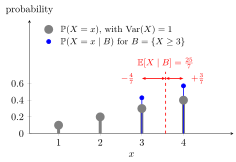
In the figure takes the values with probabilities , and leaves the values and with conditional probabilities and and conditional mean . The arrows show the deviations and ; squaring them and weighting with the conditional probabilities gives
This is much smaller than , because only two neighbouring values remain.
Conditioning on gives a new probability model, so every rule for variance holds after conditioning. In particular ; here and . The centre must be the conditional mean: centring at instead would give , which is not the conditional variance.
Conditioning does not always reduce spread. Given , the two remaining values lie far apart, and the conditional variance is , larger than . Averaged over the events of a partition, however, conditional variances never exceed ; this returns later in the law of total variance.
Key Results
- Conditional variance measures spread after conditioning on information.
- The law of total variance decomposes total variability into within-condition and between-condition parts.
- Conditional variance is zero when the condition determines the random variable exactly.
Examples
- Delivery time may have smaller variance after conditioning on the shipping method.
- Exam score variability may differ between students who studied and students who did not.
- In a mixture distribution, each component can have its own conditional variance.
Prerequisites
Related Concepts
Sources
- Probability Theory for EOR · Week 4
Keywords: variance given information, conditional Var, Conditional Variance Symbols: union
Last updated: 20 October 2026 03:02
Conditional Variance Given an EventConditional Expectation Given an EventVariance and Standard DeviationLaw of Total ProbabilityMixture Distribution