Order Statistic
Definition
Let be random variables and let be the ordered values. The random variable is called the th order statistic.
Interpretation
Order statistics describe a sample by rank rather than by the order in which the values were drawn: is the th smallest value. The most used ones are the minimum , the maximum and, for odd , the sample median.
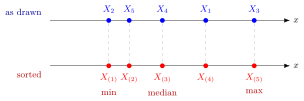
The upper row shows five values in the order in which they were drawn; the lower row shows the same five points renamed by rank. No point moves: the minimum is , the median is and the maximum is . Which draw gets which rank varies from run to run, so each is a random variable.
Even when are i.i.d., sorting need not leave them independent or identically distributed. For , the ranks are ordered, with ; for a nondegenerate sample this creates dependence and different marginal distributions. Degenerate samples, whose observations are constant, are an exception. The extremes are still easy to handle through the CDF of one observation: the maximum is at most exactly when every observation is, and the minimum exceeds exactly when every observation does, so independence gives
A middle order statistic needs a counting argument instead: means that at least of the observations are at most , and the number of such observations has the binomial distribution with parameters and .
The brackets matter: is the th smallest value, while is the th draw. For exponential observations the minimum formula returns as the minimum of independent exponentials.
Key Results
- The first order statistic is the sample minimum and the last is the sample maximum.
- Order statistics are functions of a sample.
- They are central in quantile estimation and reliability calculations.
Examples
- The smallest of five component lifetimes is the first order statistic.
- The median of a sample of odd size is the middle order statistic ; for it is .
- The maximum daily demand in a month is the largest order statistic of the daily demands.
Prerequisites
- Random Variable
- Independent and Identically Distributed Random Variables
- Cumulative Distribution Function
Related Concepts
Sources
- Probability Theory for EOR · Week 5
- Game Theory · Week 6 (revisited)
Aliases: order statistics Keywords: maximum of iid uniforms, sample maximum
Last updated: 27 October 2026 11:52
Order StatisticDensity of an Order StatisticFirst-Price AuctionRevenue Equivalence TheoremSecond-Price AuctionWinner's CurseRandom VariableIndependent and Identically Distributed Random VariablesCumulative Distribution FunctionQuantile FunctionMinimum of Independent ExponentialsProbability Density FunctionRandom Interval