Poisson Process
Definition
Let . A process with , in which counts the arrivals in , is a Poisson process with rate if it has independent increments (arrival counts in disjoint time intervals are independent) and
for all .
Interpretation
A Poisson process models random arrivals over time. It assumes arrivals occur independently and at a constant average rate.
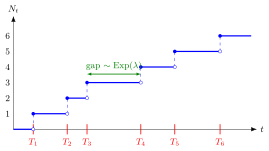
The count records arrivals in . For a Poisson process of rate , and disjoint increments are independent. The interarrival times, that is, the waiting times between consecutive arrivals, are i.i.d. exponential variables, with expected arrivals per unit time.
A stochastic process consists of variables indexed by time. The Poisson distribution specifies each interval count, while independent random variables describe counts on disjoint intervals; both properties are needed to specify the process, not just its one-time law.
Key Results
- A Poisson process has independent increments.
- The number of arrivals in an interval depends only on the interval length.
- Interarrival times in a Poisson process are independent exponential random variables.
Examples
- Customer arrivals to a store can be approximated by a Poisson process during a stable period.
- Particle emissions from a radioactive source are often modelled as a Poisson process.
- Requests to a server may be modelled as a Poisson process over short intervals.
Prerequisites
Related Concepts
Sources
- Probability Theory for EOR · Week 6
Aliases: homogeneous Poisson process, Poisson arrival process Keywords: Poisson point process, Poisson arrivals, counting process Symbols: lambda
Last updated: 20 October 2026 03:02
Poisson ProcessArrival RateCompound Poisson ProcessStochastic ProcessPoisson DistributionIndependent Random VariablesExponential DistributionMemoryless PropertyMinimum of Independent ExponentialsPoisson Splitting