Arrival Rate
Definition
Let be a Poisson process. The arrival rate is the parameter such that the expected number of arrivals in a time interval of length equals .
Interpretation
The arrival rate tells how quickly arrivals occur on average: is the expected number of arrivals per unit of time. A larger rate means more frequent arrivals and shorter waits between them.
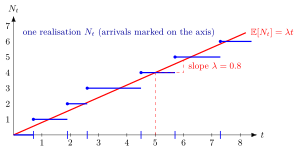
The blue staircase is one realization of : it rises by one at each arrival, and the arrival times are marked on the time axis. The red line is with slope . The staircase wanders around the line: by time it has counted six arrivals, while .
The value of depends on the time unit: per hour is per minute. It is a rate, not a probability, and can be larger than . Since , both and equal , and the probability of no arrival in is . That is also the probability that the first arrival comes after time , which is why the first waiting time has the exponential distribution with mean .
Rates of independent Poisson arrival streams add: customers arriving through one door at rate and through another at rate arrive at rate in total. The same addition of rates appears in the minimum of independent exponentials, which gives the waiting time until the next arrival in either stream.
Key Results
- In a Poisson process with rate , and .
- The first waiting time in a Poisson process with rate has an exponential distribution with mean .
- If independent Poisson processes have rates and , their superposition has rate .
Examples
- Customer arrivals at a help desk can be modelled with rate per hour, giving an expected arrivals in half an hour.
- If failures occur at rate per machine-hour, then machine-hours give an expected failures.
- Radioactive decays with larger arrival rate have shorter expected waiting times between successive decays.
Prerequisites
Related Concepts
Sources
- Probability Theory for EOR · Week 6
Aliases: intensity, rate parameter, arrival intensity, mean arrival rate Keywords: lambda rate Symbols: lambda
Last updated: 20 October 2026 03:02
Arrival RatePoisson ProcessHalf-LifeExponential DistributionStochastic Process