Random Interval
Definition
Let and be random variables with . A random interval is an interval whose endpoints are random, such as .
Interpretation
A random interval is an interval whose position and length depend on the outcome of the experiment. Before the experiment is run, is unknown; afterwards it is an ordinary interval of numbers.
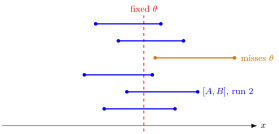
Each horizontal segment is the interval obtained in one run, and the dashed vertical line is a fixed number that is the same in every run. Five of the six segments contain ; the orange one lies entirely to its right. The randomness sits in the endpoints, not in .
The basic event is that the interval covers :
Its probability is the coverage probability. Because , the interval can miss in two disjoint ways, lying entirely to the right () or entirely to the left (), so the complement rule gives
The fraction in the figure is what happened in six runs, not the coverage probability itself.
The probability statement is about the procedure before the run. After one run, is a fixed interval that either contains the fixed or does not. A natural example is the interval between the smallest and the largest order statistic of a sample. The idea returns in statistics as the confidence interval, a random interval constructed so that its coverage probability takes a chosen value such as .
Key Results
- A random interval has endpoints that are random variables.
- Events can be formed from statements about whether a fixed value lies inside the interval.
- Random intervals are useful for uncertainty bands and coverage statements.
Examples
- A confidence interval computed from data is a random interval before the data are observed.
- The interval between two random arrival times is random.
- A forecast range with random lower and upper bounds is a random interval.
Prerequisites
Related Concepts
Sources
- Probability Theory for EOR · Week 5
Keywords: interval with random endpoints Symbols: intersection, theta
Last updated: 22 October 2026 19:04
Random IntervalRandom VariableUniform DistributionOrder Statistic