Negative Binomial Distribution
Definition
Let be a positive integer and . A random variable has a negative binomial distribution if counts the number of trials needed to obtain the th success in independent Bernoulli trials with success probability .
Interpretation
In this trial-count convention, a negative binomial distribution generalizes the first success distribution. Instead of waiting for the first success, it waits for a fixed later success.
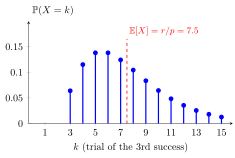
The diagram uses and . For , : the first trials have successes, and trial is the th success.
Independent random variables describe the successive trial results. Their probabilities multiply for any fixed success-and-failure sequence, after which counting the sequences that place the final success at the specified trial gives the mass function.
Key Results
- It counts waiting time until a fixed number of successes.
- For , has the first success distribution. The shifted variable has the geometric distribution used in this course.
- The failure-count convention uses instead of . For , the trial-count probability is ; the final trial is a success, and the preceding trials contain exactly successes.
Examples
- The number of sales calls needed to close five sales can be negative binomial.
- The number of coin tosses needed to obtain three heads follows a negative binomial model.
- The number of inspected items until the tenth defective item can be modelled this way under independent constant defect probability.
Prerequisites
Related Concepts
Sources
- Probability Theory for EOR · Week 3
Aliases: Pascal distribution Keywords: NBin(r,p), negative binomial random variable Symbols: element of
Last updated: 20 October 2026 03:02
Negative Binomial DistributionOverdispersion in Count ModelsFirst Success DistributionIndependent Random VariablesBinomial DistributionGamma FunctionCombinationGeometric Distribution