Conditional Expectation Given an Event
Definition
Let be an event with and let be integrable. Its conditional expectation given is the average under the conditional probability model:
For discrete , this equals . When the conditional law has a density , it equals . Conditioning on an event gives a number; conditioning on a random variable gives a random variable and is treated separately in Probability Distributions (conditional expectation given a random variable).
Interpretation
The conditional expectation is the average value of when only the outcomes in an event that is known to have occurred are considered. It is computed like an ordinary expectation, with the conditional probabilities given as weights.
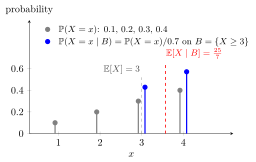
In the figure takes the values with probabilities , so . Given , with , the values and drop out, and the masses and are rescaled to and so that they again add up to . The conditional mean lies to the right of because only the large values remain.
In the formula , the indicator sets to zero on the outcomes outside , so the numerator adds up only over ; dividing by renormalizes those weights to total one. In the figure and . The condition is needed because the division is otherwise undefined. A common slip is to stop at : here is smaller than every value takes on , so it cannot be the average over .
Conditioning on and on its complement and averaging the two results with weights and gives back , the expectation version of the law of total probability. In the figure , and .
Key Results
- .
- For constants and integrable , .
Examples
- For a fair die conditioned to be even, the mean is .
- For conditioned on , the mean is .
Prerequisites
Related Concepts
- Law of Total Probability
- Mixture Distribution
- Distribution
- Conditional Density Given an Event
- Conditional Expectation Given a Random Variable
Sources
- Probability Theory for EOR · Week 4
- Nicky van Foreest · Probability Distributions · Week 4
Aliases: conditional mean given an event Keywords: expected value given information, Conditional Expectation Symbols: integral, real numbers, sum
Last updated: 20 October 2026 03:02
Conditional Expectation Given an EventConditional Variance Given an EventLaw of Total Expectation over a PartitionProspective Policy ValueAdverse SelectionBayesian Nash EquilibriumCommon-Value AuctionMarket for LemonsWinner's CurseExpectationConditional ProbabilityLaw of Total ProbabilityMixture DistributionDistributionConditional Density Given an EventConditional Expectation Given a Random Variable