Conditional Density Given an Event
Definition
Let be a continuous random variable and an event with . The conditional CDF of given is
Where the derivative exists, the conditional density of given is
Equivalently, by Bayes' rule,
Here is the conditional probability given the value , determined except possibly on a set of values of probability zero, where it may be chosen arbitrarily; it is not an elementary ratio, whose denominator would be zero.
Interpretation
Conditioning on an event reweights the original density of by how compatible each value is with , and then divides by so that the total area is again .
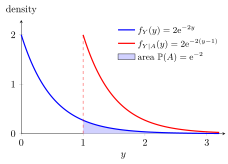
In the illustrated example, and , with . Keep the shaded part of the density on and divide by : for and elsewhere. The red curve is the original density shifted one unit to the right, the memoryless property.
The Bayes form of the definition covers two kinds of event. If is decided by itself, then is on and outside it, and conditioning simply cuts the density to and rescales it. If also depends on other randomness, lies between and and the density is reweighted smoothly. For example, let and let be the event that a coin with success probability shows heads; then , and on .
With this density, the conditional expectation given an event from Probability Theory is ; in the figure it equals . Conditioning on the value of another variable, which has probability zero, needs the conditional PDF instead.
Cutting without rescaling is a common slip: the cut density on integrates to , not .
Key Results
- If , then except possibly on a set of zero length.
- The conditional density integrates to one whenever .
Examples
- For and , the conditional density is on .
- For and , the conditional density is for .
Prerequisites
Related Concepts
- Conditional Probability Density Function
- Conditional Expectation Given an Event
- Conditional Cumulative Distribution Function
Sources
- Nicky van Foreest · Probability Distributions · Week 4
Symbols: element of, integral
Last updated: 20 October 2026 03:02
Conditional Density Given an EventProbability Density FunctionConditional ProbabilityConditional Probability Density FunctionConditional Expectation Given an EventConditional Cumulative Distribution Function