Law of Total Expectation over a Partition
Theorem
If is a finite or countable partition of the sample space and is integrable, then
where terms with are omitted. The law of total probability (LOTP) is the special case of this partition form of the law of total expectation; the random-variable form is Adam’s Law.
Interpretation
The overall average is a weighted average of the averages within disjoint cases: split the sample space into cases, find the mean of in each case, and weight each case mean by the probability of the case.
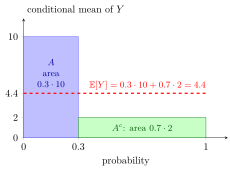
In the diagram, the two cases have probabilities and , drawn as bar widths, and conditional means and , drawn as bar heights. Each term is the area of a bar, and . The dashed level has the same total area.
The cases must be disjoint so that no outcome is counted twice, and must cover the sample space so that none is missed; that is what a partition guarantees. A case with has no conditional mean, but it also contributes nothing, so it is left out.
The theorem is useful when the cases make simple. For the number of tosses up to and including the first head, with head probability , condition on the first toss; after a tail the count starts afresh, so , giving , the mean of the first success distribution. With the theorem becomes the law of total probability, and with the cases for a discrete it becomes Adam’s law.
The weights are the case probabilities, not equal weights: the unweighted average is wrong.
Key Results
- For a partition , .
- Putting gives the law of total probability.
Examples
- If two equally likely customer groups have mean spending and , overall mean spending is .
- If , , and , then .
Prerequisites
Related Concepts
Sources
- Nicky van Foreest · Probability Distributions · Week 4
Symbols: sum
Last updated: 20 October 2026 03:02
Law of Total Expectation over a PartitionConditional Expectation Given an EventPartition of a SetLaw of Total ProbabilityAdam’s Law: Total Expectation