Conditional Cumulative Distribution Function
Definition
Let and be continuous random variables with joint density , and let satisfy . The conditional CDF of given is
Here
We write . Note that for continuous , this cannot be defined by the elementary formula , because .
The integrand is the Conditional Probability Density Function. Integrating it up to gives the conditional threshold probability in exactly the same way that an unconditional PDF gives a CDF.
Interpretation
A conditional CDF gives threshold probabilities within a specified conditional distribution: is the probability that once is known. For each fixed it is an ordinary CDF in , obtained from the conditional density just as a CDF is obtained from a PDF.
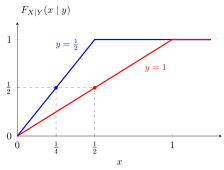
The diagram shows the conditional CDFs of for (blue) and (red). Each graph rises in a straight line from at to at , following , and passes at : at for and at for . Changing changes the whole conditional distribution, not just one value.
The notation cannot be read through the elementary formula , because for continuous . It is defined through the conditional density instead, and the condition makes the ratio meaningful. For independent and , the conditional CDF equals the unconditional for -almost every conditioning value . One may choose a version equal to for every ; other versions can differ on conditioning values of probability zero.
Averaging the conditional CDFs over gives back : integrating the continuous law of total probability in gives . In the triangle model of the conditional density page, on and when , so for
Key Results
- For every with , it is a nondecreasing, right-continuous CDF in .
- Where differentiation is justified, except possibly on a set of zero length.
Examples
- For the uniform conditional law on , for , so .
- If is independent of , then for .
Prerequisites
Related Concepts
Sources
- Nicky van Foreest · Probability Distributions · Week 2
Aliases: conditional CDF, conditional distribution function Symbols: infinity, integral, intersection, partial
Last updated: 27 October 2026 11:52
Conditional Cumulative Distribution FunctionConditional Probability Density FunctionCumulative Distribution FunctionIndependent Random VariablesConditional Density Given an Event