Sum of Two IID Uniform Variables
Proposition
If are independent variables, then has density
The density peaks at .
Each Uniform Distribution on has density one there. The Convolution of Independent Random Variables integral reduces to the length of the overlap between and , producing for and for .
Interpretation
Two independent uniform values have more ways to add up near the centre than near either endpoint. Their sum therefore has a triangular density on with its peak at .
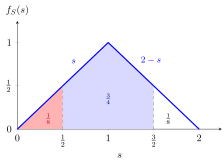
The red triangle on has base and height , so ; by symmetry the right tail has the same probability, and the middle part from to carries the remaining , as in the Examples.
The result can also be read in the unit square, where the pair is uniform. The event is the part of the square below the line ; for it is a triangle of area , which is the CDF, and its derivative is the density. The density is symmetric about because has the same distribution as . Mean and variance follow without the density: , and by independence .
This is the continuous counterpart of the triangular distribution of the sum of two dice, which peaks at . Adding more independent uniforms makes the shape smoother and more bell-shaped, an effect that returns later as the central limit theorem.
The sum of two uniforms is not uniform on : that would give , twice the correct value .
Key Results
- and .
- The CDF is on and on .
Examples
- .
- .
Prerequisites
Related Concepts
Sources
- Nicky van Foreest · Probability Distributions · Week 3
Keywords: triangular distribution
Last updated: 20 October 2026 03:02
Sum of Two IID Uniform VariablesUniform DistributionConvolution of Independent Random VariablesVariance and Standard Deviation