Taking Out What Is Known
Proposition
Let be a Borel-measurable function, and let and be integrable (for example, bounded). Then, almost surely,
Inside the Conditional Expectation Given a Random Variable, fixing fixes . It therefore acts as a constant in the conditional sum or integral, subject to the stated integrability assumptions.
Interpretation
Once is observed, any function of it is a known number, so it acts as a constant inside the conditional average. The rule is the conditional version of .
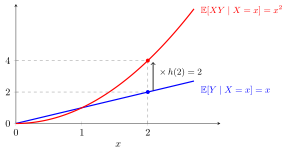
In the illustrated example, , so the blue line is , and . At the blue value is multiplied by the known factor to give the red value of . In general ; here .
At a fixed value , the rule is ordinary linearity of expectation with the constant ; substituting the random afterwards gives the stated identity. The integrability assumptions make both sides well defined, which is automatic when is bounded.
Combined with Adam’s law, the rule gives , a standard way to compute mixed moments in two-stage models. In the Poisson example, , so . The same step shows that independence implies zero covariance, see conditional expectation and independence.
Only functions of the conditioning variable come out. A function of is not known given : is in general not , and in the Poisson example it equals .
Key Results
- when is integrable.
- Combining the rule with Adam’s law gives .
Examples
- If and , then .
- If , then .
Prerequisites
Related Concepts
Sources
- Nicky van Foreest · Probability Distributions · Week 4
Aliases: pull-out property, taking out what's known, pulling out what is known, pulling out known factors Symbols: infinity
Last updated: 20 October 2026 03:02
Taking Out What Is KnownConditional Expectation Given a Random VariableAdam’s Law: Total ExpectationEve’s Law: Total Variance