Chicken–Egg Theorem
Theorem
Let , and . If and, given , for every , then and , and and are independent.
The Poisson Distribution supplies the random total . Given that total, the Conditional Probability Mass Function of is a Binomial Distribution PMF: independently labelling items produces a binomial count before averaging over .
Interpretation
A Poisson total divided by binomial labelling produces two independent Poisson counts, even though their sum is the original total. The name comes from the picture in the figure: a Poisson number of eggs is laid, and each egg hatches independently with probability .
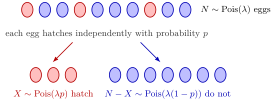
In the sample shown, ten eggs are laid; three hatch (red) and seven do not (blue). Over repeated samples the hatched count is , the unhatched count is , and the two counts are independent: for instance, and give and .
The surprise is the independence. For a fixed total the counts are dependent, since they must add up to : many hatched eggs force few unhatched ones. Given , both counts are constant zero and are independent. With a Poisson total this dependence disappears, because the joint PMF factorizes:
This follows from by writing and ; the factorials cancel. The Poisson assumption on is what makes the exponential factor split in this way; for other distributions of the total the counts are in general dependent.
The theorem is the basis of Poisson splitting into labelled categories. Read in the other direction, it matches Poisson merging: two independent Poisson counts add up to a Poisson total, and given that total, the first count is binomial.
Key Results
- If , then and independently.
- Given , the two counts are dependent: they add to , so forces . Given , both are constant zero.
Examples
- If and , then and independently.
- With , , .
Prerequisites
- Poisson Distribution
- Binomial Distribution
- Conditional Probability Mass Function
- Independent Random Variables
Related Concepts
Sources
- Nicky van Foreest · Probability Distributions · Week 1
Symbols: lambda
Last updated: 27 October 2026 11:52
Chicken–Egg TheoremPoisson SplittingPoisson DistributionBinomial DistributionConditional Probability Mass FunctionIndependent Random VariablesPoisson Merging