Moment
Definition
Let be a random variable and let be a natural number. If , the th moment (or raw moment, moment about the origin) of is
Writing for the first moment, the th central moment (moment about the mean) is
If , the th moment does not exist. Both moments are expectations of a function of , so by LOTUS they are computed from the PMF as or from the PDF as , and similarly with .
Interpretation
Moments summarize a distribution through averages of powers. Raw moments are measured from ; central moments are measured from the mean, so they describe the shape of the distribution around its centre and do not change when is shifted. Higher powers give large deviations more weight, so higher moments are increasingly sensitive to the tails.
For taking the values with probabilities :
- raw moments: , and ;
- central moments: the deviations from are , so the second central moment is and the third is .
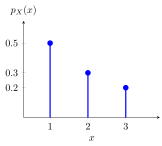
The positive third central moment reflects the long right tail: the single large deviation outweighs the more likely deviation once it is cubed.
The order of operations matters. The second moment averages the squares, whereas squares the average; here against . Their difference is the second central moment, .
Key Results
The first moment is the expectation, and the first central moment is always . The second central moment is the variance; expanding the power and using linearity of expectation expresses central moments through raw moments:
The cross terms do not cancel: the third central moment is not . When the third moment exists and the standard deviation satisfies , the third central moment divided by is the skewness, a measure of asymmetry. This standardized coefficient is undefined for a constant random variable, for which .
- Since a variance is never negative, , with equality exactly when is constant almost surely.
- For constants , the th central moment of is (not ) times that of . In particular, shifting by leaves all central moments unchanged, and the odd central moments change sign when . Raw moments are not shift-invariant: .
- If the th moment exists, so does every th moment with , because . The converse fails: moments can fail to exist for heavy-tailed distributions even when lower moments are finite.
- If is bounded, say , every moment exists and .
- For an indicator random variable , , so every moment equals .
- If the moment generating function is finite on an open interval around , all moments exist and (moments from the MGF).
Examples
- For a fair die, and , so .
- For (Bernoulli distribution), , so for every and .
- For , , so .
- For , ; the second central moment is .
- For the three-point above and , , the second central moment of is and the third is .
- If has a symmetric distribution about its mean, every odd central moment that exists is : the deviations and have the same distribution.
- The density for has finite mean , but , so its variance does not exist.
Prerequisites
Related Concepts
- Variance and Standard Deviation
- Moment Generating Function
- Moments from the MGF
- Symmetric Distribution
- Linearity of Expectation
- Bernoulli Distribution
Sources
- Nicky van Foreest · Probability Distributions · Week 1
Aliases: raw moment, moment about the origin, central moment, moment about the mean Keywords: nth moment, first moment, second moment, nth central moment, E[X^r], existence of moments Symbols: infinity, integral, lambda, mu, sigma, sum
Last updated: 27 October 2026 11:52
MomentMoments from the MGFExpectationRandom VariableLOTUSVariance and Standard DeviationMoment Generating FunctionSymmetric DistributionLinearity of ExpectationBernoulli Distribution