Joint CDF of Continuous Random Variables
Definition
The joint CDF of a random pair is
It exists for every random pair, including pairs without a joint PDF. This page develops its form for pairs with a joint density; the discrete form is on Joint CDF of Discrete Random Variables.
Interpretation
The joint CDF is the probability that the pair lands in the lower-left quadrant of the plane. This one function determines the whole joint distribution, and a joint density allows it to be calculated by a double integral.
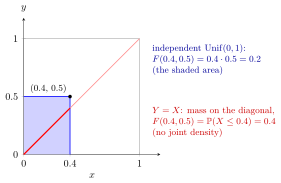
For independent uniforms, probability is spread evenly over the square, so is the area . For , all probability lies on the diagonal, and the quadrant contains the diagonal piece up to , so . Both pairs have marginals, so the marginals alone do not determine the joint CDF.
As a function of two variables, is nondecreasing in each argument, tends to when either argument tends to , and tends to the marginal CDF when . Where it is smooth enough, the joint density is recovered as the mixed partial derivative ; for independent uniforms, on the unit square and this derivative is . Moreover, and are independent if and only if for all .
The definition is the same as for discrete pairs; only the way of computing it changes, from a double sum of a joint PMF to a double integral of a joint density.
The upper-right quadrant is not the complement of the lower-left one: , not . For independent uniforms at this is , not .
Key Results
- With a joint density, .
- Rectangle probabilities follow by inclusion-exclusion: for .
Examples
- For independent variables, .
- If , then ; this pair has no joint PDF.
Prerequisites
Related Concepts
- Joint CDF of Discrete Random Variables
- Joint Probability Density Function
- Independent Random Variables
Sources
- Nicky van Foreest · Probability Distributions · Week 2
Keywords: joint CDF, joint distribution function Symbols: infinity, integral, partial
Last updated: 20 October 2026 03:02
Joint CDF of Continuous Random VariablesCumulative Distribution FunctionJoint CDF of Discrete Random VariablesJoint Probability Density FunctionIndependent Random Variables