Multinomial Distribution
Definition
Let be an integer and with and . A random vector has a multinomial distribution, written , if for all integers with
with when a category probability is zero; the PMF is zero otherwise. The margins are binomial: .
The displayed formula is the Joint Probability Mass Function of all category counts. Each single count has a Binomial Distribution, since each trial either lands in that category or does not.
Interpretation
A multinomial vector counts outcomes in several categories across a fixed number of independent trials. Its category counts must add to the fixed total.
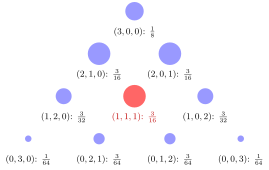
The diagram uses trials with category probabilities . Each disc represents a count vector whose entries sum to , and its area is proportional to the probability given by the PMF above. The red disc marks , with probability , calculated in the first example below. The counts are dependent because their total is fixed.
Key Results
- , so and .
- For , .
Examples
- For and category probabilities , .
- For and probabilities , and .
Prerequisites
Related Concepts
Sources
- Nicky van Foreest · Probability Distributions · Week 2
Symbols: sum
Last updated: 14 October 2026 08:21
Multinomial DistributionBinomial DistributionJoint Probability Mass FunctionPoisson SplittingCovarianceBinomial Theorem