Eve’s Law: Total Variance
Theorem
For random variables and with ,
Consequence: the residual is uncorrelated with every function that has (or satisfies another assumption that makes the products integrable):
The first term averages the Conditional Variance Given a Random Variable; the second is the ordinary Variance and Standard Deviation of the conditional mean. To derive the identity, apply Adam’s Law: Total Expectation to and expand both variances as second moment minus squared mean.
Interpretation
Total spread consists of average spread within conditional groups plus spread between their conditional means. Knowing splits the variance of into a part that explains, how much the group centres move, and a part that remains, how much varies inside a group.
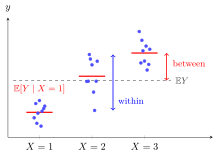
The figure groups values of by . The short red lines are the group means and the dashed line is the overall mean . The first term, , averages the spread of the points around their own red line (the arrow "within"). The second term, , measures how far the red lines lie from the dashed line (the arrow "between").
Two extreme cases show what each term means. If is a function of , every group is a single point, the first term is and all variance lies between groups. If is independent of , every group mean equals by conditional expectation and independence, so the second term is and explains nothing. Both terms are nonnegative, which gives the Key Result : replacing by its conditional mean can only reduce variance.
The practical form of the identity is the conditioning trick for variance. A frequent slip is to drop one of the two terms, or to write the first term as the random variable instead of its average .
Key Results
- .
- The residual has mean zero and for every square-integrable .
Examples
- If and , then .
- If and , then .
Prerequisites
- Conditional Variance Given a Random Variable
- Adam’s Law: Total Expectation
- Variance and Standard Deviation
Related Concepts
Sources
- Nicky van Foreest · Probability Distributions · Week 6
Aliases: law of total variance, variance decomposition formula Symbols: infinity
Last updated: 22 October 2026 19:04
Eve’s Law: Total VarianceConditioning Trick for VarianceConditional Variance Given a Random VariableAdam’s Law: Total ExpectationVariance and Standard DeviationCovarianceTaking Out What Is Known