Conditioning Trick for Variance
Method
When has a natural conditional structure, for example , compute by decomposing it with Eve's law (total variance). This is a calculation method rather than a separate theorem; it needs .
Interpretation
When the distribution of is awkward but becomes simple once another variable is known, compute its mean and variance in two layers: first for fixed , then over , combined by total variance. This avoids finding the marginal distribution of .
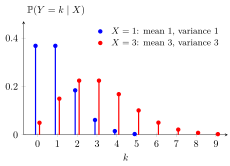
The figure shows the two cases of the first Example: equals or with probability each, and . The average conditional variance, the spread within each bar chart, is . The variance of the conditional means and , the spread between the charts, is . The total variance is therefore .
The method has three steps. Name the variable that makes simple; write down and , here the Poisson mean and variance; then compute and from the distribution of alone. The last step needs only the mean and variance of , which is why the Key Result holds for every with finite second moment. The mean is the same calculation with Adam's law.
The second term is easy to forget. Here exceeds , although every conditional Poisson law has variance equal to its mean: the randomness of the rate adds variance. This idea returns later in insurance, where a Poisson claim count with a random rate explains claim counts whose variance exceeds their mean (overdispersion).
Key Results
- Compute and first; then .
- For with finite second moment of , and .
Examples
- If is equally likely to be or and , then and .
- If and , the within variance is , the conditional-mean variance is , and total variance is .
Prerequisites
Related Concepts
Sources
- Nicky van Foreest · Probability Distributions · Week 6
Symbols: infinity
Last updated: 20 October 2026 03:02
Conditioning Trick for VarianceCompound Risk DistributionEve’s Law: Total VariancePoisson DistributionAdam’s Law: Total ExpectationConditional Variance Given a Random Variable