Two-Dimensional LOTUS for Continuous Variables
Theorem
For a jointly continuous pair and a Borel-measurable function with ,
For the formula also holds without this assumption, as an extended (possibly infinite) expectation.
Interpretation
Two-dimensional LOTUS computes the mean of a function of a continuous pair directly from the joint density: weight each value by and integrate over the plane. The distribution of the new random variable is never needed, and the pair need not be independent.
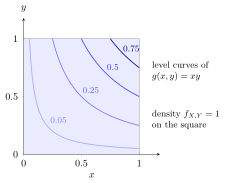
On the unit square the density is , so is simply the average of over the square. Along each blue level curve the function has the constant value , and most of the square lies where is small. Here , without finding the distribution of .
The theorem is the LOTUS of Probability Theory with a double integral instead of a single one, and the continuous counterpart of the discrete two-dimensional version. The integrability condition makes the integral a well-defined finite number; for it may be dropped if an infinite answer is allowed. Choosing gives the standard quantities: gives for the covariance, gives for any dependence provided and , and an indicator of a region gives its probability.
For the dependent pair with density on , , while and . So . For independent variables the double integral factors and .
In general : for the triangle, but .
Key Results
- For , the integral gives .
- For an indicator of a region , it gives .
Examples
- For independent uniform coordinates on , .
- For density on , .
Prerequisites
Related Concepts
Sources
- Nicky van Foreest · Probability Distributions · Week 2
Keywords: LOTUS Symbols: element of, infinity, integral
Last updated: 27 October 2026 11:52
Two-Dimensional LOTUS for Continuous VariablesJoint Probability Density FunctionExpectationTwo-Dimensional LOTUS for Discrete VariablesLOTUSCovariance