Marginal Probability Mass Function
Definition
For a discrete random pair with joint PMF , the marginal PMF of is
where the sum runs over all possible values of .
Interpretation
A marginal PMF describes one component of a random pair after the other component has been summed out. Summing over all values is the law of total probability for the partition formed by the events : .
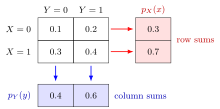
In the table the rows are the values of and the columns the values of . The row sums and give ; the column sums and give . The name comes from writing these sums in the margins of the table.
Going from the joint PMF to the marginals loses information: the marginals do not determine the joint PMF. The pair and a pair of independent fair coins have the same marginals but different joint PMFs. Only for independent variables is the joint PMF the product ; the table above is not of this kind, since .
The marginal of is the denominator of the conditional PMF of given . For pairs with a joint density, the marginal density is found in the same way, with the sum replaced by an integral.
Key Results
- and .
- Marginalization preserves normalization: .
Examples
- If the masses at are , then and .
- For independent fair dice, summing the six masses in a row gives .
Prerequisites
Related Concepts
Sources
- Nicky van Foreest · Probability Distributions · Week 1
Aliases: marginal PMF, marginal mass function Symbols: sum
Last updated: 20 October 2026 03:02
Marginal Probability Mass FunctionConditional Probability Mass FunctionJoint Probability Mass FunctionMarginal Probability Density FunctionIndependent Random Variables