Sample Mean
Definition
For random variables and , their sample mean is
The sum adds the observations before dividing by . No independence assumption is needed to define this arithmetic average.
Interpretation
The sample mean summarizes observations by their arithmetic average. Before the data are observed, is a random variable with its own expectation, variance and sampling distribution; the observed average is one realized number.
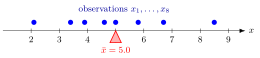
The figure marks eight observations on a number line. Their mean is the balance point: the deviations to the left and right cancel, . A single far-away observation moves the balance point; replacing by raises the mean by to .
Two properties make a useful estimate of the population mean . It is centred correctly, , which needs only linearity of expectation. With independent observations of common variance , its variance shrinks, so the standard deviation halves when the sample size is multiplied by four. Without independence the second property can fail: if all equal , then has variance for every .
These two properties lead to the weak and strong law of large numbers, which say that approaches , and to the central limit theorem, which describes the shape of the remaining error. A common confusion is between and : the sample mean is computed from data and varies from sample to sample, while is a fixed property of the distribution.
Key Results
- If every has mean , then without independence.
- If the observations are independent with common variance , then .
Examples
- For observations , the observed sample mean is .
- For i.i.d. observations, the sample mean has expectation and variance .
Further Properties
For realized observations , the observed average is . A sample proportion is the sample mean of success indicators.
Prerequisites
Related Concepts
Sources
- Probability Distributions · supporting concept
Aliases: sample average, empirical mean, X bar Symbols: mu, sigma, square root, sum
Last updated: 20 October 2026 03:02
Sample MeanCentral Limit TheoremStrong Law of Large NumbersWeak Law of Large NumbersAddition and SumRandom VariableExpectation