Conditional Probability Density Function
Definition
Let and have joint density , and let satisfy . The conditional PDF of given is
The denominator is the density , not . On a set of conditioning values of probability zero, for example finitely many points, conditional laws may be chosen arbitrarily.
The Marginal Probability Density Function in the denominator is obtained by integrating the joint density over the other coordinate. Dividing by it makes the conditional density integrate to one.
Interpretation
A conditional density describes one variable after a continuous value of another is observed. It uses a ratio of densities, rather than dividing by the probability of a zero-probability event: the slice of the joint density at is rescaled by so that it has total area .
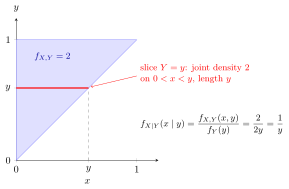
The joint density equals on the triangle . Along the horizontal slice at height it equals on , a segment of length , so the marginal density is . Dividing gives on : given , is uniform on .
The formula mirrors the conditional PMF , with densities in place of masses. Heuristically, conditioning on a thin strip , which has positive probability, produces a factor in both the joint and the marginal probability; it cancels, leaving the ratio of densities. Like any density, is not a probability and can exceed : in the triangle it equals when . Changing the conditional density for a set of -values of probability zero changes no probability, which is why the definition allows arbitrary choices there.
Multiplying back, builds a joint model in two stages, and integrating over gives the continuous law of total probability. For independent and the conditional density is simply , and integrating up to gives the conditional CDF.
Key Results
- For every with , .
- except possibly on a set of zero area.
Examples
- For joint density on , on : a uniform conditional law.
- For independent and , for .
Prerequisites
Related Concepts
- Conditional Probability Mass Function
- Independent Random Variables
- Conditional Density Given an Event
Sources
- Nicky van Foreest · Probability Distributions · Week 2
Aliases: conditional PDF, conditional density, conditional density function Symbols: infinity, integral
Last updated: 20 October 2026 03:02
Conditional Probability Density FunctionBayes and Total Probability: Four FormsConditional Cumulative Distribution FunctionConditional Expectation Given a Random VariableContinuous Bayes RuleContinuous Law of Total ProbabilityJoint Probability Density FunctionMarginal Probability Density FunctionConditional Probability Mass FunctionIndependent Random VariablesConditional Density Given an Event