Jensen Inequality
Theorem
Let be an integrable random variable taking values in an interval on which is convex. If exists (in the finite-valued form, ), then
The inequality reverses for concave .
The Expectation is the weighted average in this result. Convexity compares the function evaluated at that average with the average of the function values.
Interpretation
For a convex function, averaging before applying the function gives no larger a value than applying it first and then averaging: . In general an expectation cannot be moved through a nonlinear function, and convexity tells in which direction the error goes.
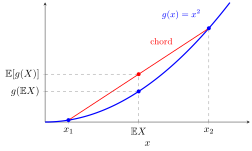
In the figure takes two values and with probability each, so is their midpoint. The chord joins the points of the graph of above and ; above its height is the average , while the curve has height . A convex graph lies below its chords, so . For a variable with two values this is exactly the definition of convexity, with the probabilities as weights; Jensen's inequality extends it to every distribution.
With , Jensen gives , that is , as in the first Example. For the concave the inequality reverses, .
A common slip is to replace by for a nonlinear . For positive , is convex on , so ; if is or with equal probability, these are and . This idea returns later in insurance: with a concave utility, the expected utility of an uncertain wealth is at most the utility of its expected value.
Key Results
- For a concave function, the inequality reverses.
- If is strictly convex and both sides are finite, equality holds exactly when is constant almost surely.
Examples
- For and , .
- For or with equal probability, concavity of gives .
Prerequisites
Related Concepts
Sources
- Nicky van Foreest · Probability Distributions · Week 7
Aliases: Jensen's inequality Symbols: infinity
Last updated: 20 October 2026 03:02
Jensen InequalityExpected Utility and Risk AversionStop-Loss OrderExpectationConvexity and ConcavityVariance and Standard DeviationMoment Generating Function