Marginal Probability Density Function
Definition
For a jointly continuous pair with joint density , the marginal PDF of is
where the integral runs over the values allowed for the other coordinate; the density is zero outside the joint support.
Interpretation
The marginal density of is the density of on its own, ignoring . Integrating out the other coordinate of the joint density collapses the probability in the plane onto the -axis.
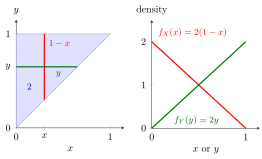
For the illustrated triangular density, the red vertical slice at runs from to and has length , so for . The green horizontal slice at has length , so for .
The value approximates the probability of a thin vertical strip of width at , which is the volume under the joint density over that strip. When the support is not a rectangle, the limits of the inner integral depend on , as in the triangle. This is the continuous version of adding up a row of a joint PMF table to get a marginal PMF.
Marginal densities are the denominator of a conditional density, and the continuous law of total probability rewrites the same integral with conditional densities. The marginals do not determine the joint density: on the unit square, both and have marginals. The joint density is the product of the marginals exactly in the independent case.
Ignoring the support is the usual error: integrating over gives the constant , which integrates to in , so it cannot be a density.
Key Results
- .
- Each marginal integrates to one, since the joint density does.
Examples
- If on , then for .
- For the same triangle, for .
Prerequisites
Related Concepts
Sources
- Nicky van Foreest · Probability Distributions · Week 2
Aliases: marginal PDF, marginal density, marginal density function Symbols: delta, element of, integral, real numbers
Last updated: 20 October 2026 03:02
Marginal Probability Density FunctionConditional Probability Density FunctionContinuous Law of Total ProbabilityJoint Probability Density FunctionMarginal Probability Mass FunctionIndependent Random Variables