Joint Probability Mass Function
Definition
For discrete random variables and , the joint PMF is
This is the Probability Mass Function of the pair: it assigns a mass to each possible ordered outcome, and summing those masses over an event gives its probability.
Interpretation
A joint PMF assigns probability to each pair of discrete values and describes how the variables behave together: the probability of any event about the pair is the sum of the masses in that event.
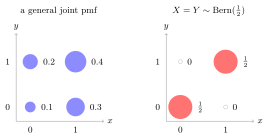
Each disc sits at a pair , and its size shows the mass . On the left the four masses , , and add up to . On the right : all mass lies on the diagonal, at and at , and the pairs and have mass .
The joint PMF holds more information than the two separate PMFs. In the right panel each of and is , exactly as for two independent fair coins, where each of the four pairs has mass ; only the joint PMF tells the two situations apart. The separate PMFs are recovered as marginal PMFs by summing over the other variable, and independence means that every joint mass is the product of the two marginal masses.
Several notions are built directly on the joint PMF: the conditional PMF rescales the masses with one fixed value of , the joint CDF adds the masses in a lower-left corner, and two-dimensional LOTUS averages a function against them. For pairs of continuous variables, the joint density plays the same role, with sums replaced by integrals.
Key Results
- and .
- For a set of pairs, .
Examples
- Two independent fair dice have for .
- If , the masses at and are , and all other masses are zero.
Prerequisites
Related Concepts
Sources
- Nicky van Foreest · Probability Distributions · Week 1
Aliases: joint PMF, joint mass function Symbols: element of, sum
Last updated: 20 October 2026 03:02
Joint Probability Mass FunctionConditional Probability Mass FunctionTwo-Dimensional LOTUS for Discrete VariablesMarginal Probability Mass FunctionMultinomial DistributionProbability Mass FunctionJoint CDF of Discrete Random VariablesIndependent Random Variables