Exponential Limit
Theorem
For every real ,
Here for all sufficiently large , which the usual logarithm argument needs.
For each fixed , the Limit of a Sequence of the powers equals the value of the Exponential Function at that same .
Interpretation
Many small multiplicative changes combine into an exponential. Growing by the factor in each of steps gives the total factor , and as the steps become smaller and more numerous this total approaches . The same limit explains how rare-event binomial probabilities approach Poisson probabilities.
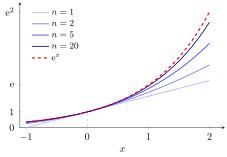
The curves for lie below the red dashed curve and move up towards it as grows. At they take the values , , about and about , against : for each fixed the gap shrinks, but slowly where is far from .
Taking the logarithm shows why the limit is : is close to , because for small . This is also why the statement needs : the logarithm requires a positive argument, which holds for all large even when is negative.
With the limit reads . For this is : in many trials with a small success probability and mean , the chance of no success approaches , the Poisson probability of zero. Applied to the MGF of , the limit gives , the MGF of .
Key Results
- For fixed , .
- For fixed , .
Examples
- .
- If for , then .
Prerequisites
Related Concepts
Sources
- Nicky van Foreest · Probability Distributions · Refresher
Keywords: compound interest limit Symbols: infinity, lambda
Last updated: 20 October 2026 03:02
Exponential LimitLimit of a SequenceExponential FunctionBinomial DistributionPoisson Distribution