Adam’s Law: Total Expectation
Theorem
For random variables and with ,
Interpretation
Adam’s law computes a mean in two steps: first the mean of within each scenario , then the average of these conditional means over the distribution of . Averaging the conditional average recovers the original average.
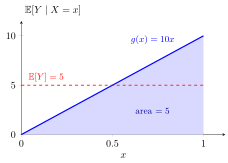
For and , the conditional mean is . Since has density on , the average of is the shaded area under the line, , which is the height of the dashed line .
The inner expectation is a random variable; the outer one averages it with the distribution of , by LOTUS: a sum over for discrete , an integral against for continuous . The condition makes both sides finite and well defined. The method pays off in two-stage models, where the conditional law of is simple but its unconditional law is not.
For a discrete the law is the law of total expectation over a partition with the cases , and taking an indicator gives back the law of total probability, discrete or continuous. The corresponding rule for variances returns later as Eve’s law.
The outer average must use the distribution of : if had density on instead, the same conditional means would give , not .
Key Results
- For discrete , ; for density , use the corresponding integral.
- Conditioning on more information first and then on less gives the conditional expectation given the smaller information: (Adam's law with extra conditioning).
Examples
- If and , then .
- If and , then .
Prerequisites
Related Concepts
- Law of Total Expectation over a Partition
- Fundamental Bridge
- Linearity of Expectation
- Continuous Law of Total Probability
- Taking Out What Is Known
- Conditioning Trick for Variance
Sources
- Nicky van Foreest · Probability Distributions · Week 4
Aliases: law of total expectation, total expectation formula, law of iterated expectations, tower property, law of double expectation Symbols: infinity, integral, sum
Last updated: 20 October 2026 03:02
Adam’s Law: Total ExpectationAdam’s Law with Extra ConditioningEve’s Law: Total VarianceCompound Risk DistributionConditional Expectation Given a Random VariableLaw of Total Expectation over a PartitionFundamental BridgeLinearity of ExpectationContinuous Law of Total ProbabilityTaking Out What Is KnownConditioning Trick for Variance