Fundamental Bridge
Proposition
For any event , let equal one on and zero outside . The fundamental bridge is
The expectation always exists because the indicator is bounded.
Interpretation
The fundamental bridge says that the probability of an event equals the expected value of its indicator. It lets every probability be written as an expectation, and every expected count as a sum of probabilities.
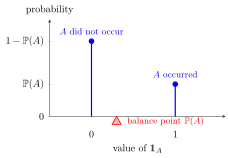
In the figure : the indicator equals with probability , when did not occur, and with probability , when it did. Treating the two bars as weights, their balance point, the expectation, lies at .
The proof is one line, since is a Bernoulli variable with parameter . The identity becomes useful together with linearity of expectation: if counts how many of the events occur, then , whether or not the events are independent. For tosses with heads probability this gives the binomial mean . If letters are put into envelopes at random, letter lands in its own envelope with probability , so the expected number of correctly placed letters is for every , although these events are dependent.
The bridge does not say that equals . The indicator only takes the values and ; is its average value, and it is usually not a value the indicator takes.
Key Results
- .
- for finitely many events, without independence.
Examples
- For an even result on a fair die, .
- For components each failing with probability , the expected failure count is , even if failures are dependent.
Prerequisites
Related Concepts
- Linearity of Expectation
- Inclusion-Exclusion Principle
- Law of Total Probability
- Adam’s Law: Total Expectation
Sources
- Probability Theory for EOR · Week 4
- Nicky van Foreest · Probability Distributions · Refresher
Aliases: indicator bridge, expectation of an indicator Keywords: probability-expectation bridge Symbols: sum
Last updated: 20 October 2026 03:02
Fundamental BridgeIndicator Random VariableExpectationProbability FunctionEventLinearity of ExpectationInclusion-Exclusion PrincipleLaw of Total ProbabilityAdam’s Law: Total Expectation