Function of a Random Variable
Definition
Let be a random variable and let be a Borel-measurable function, meaning that preimages of Borel sets are Borel sets. Continuous and piecewise continuous functions satisfy this condition. The function of a random variable determined by is the random variable .
Interpretation
A function of a random variable is a new quantity computed from the value of . On each outcome it takes the value , so is the composition of and .
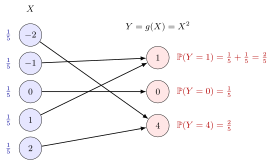
In the figure is uniform on , each value with probability , and . The values and are both sent to , and and both to , so their probabilities add: , and . is discrete uniform, but is not. In general, for discrete ,
For a discrete this is the whole recipe: list the values of , and for each value add the masses of all with . If is one-to-one, no masses merge, and has the same masses as , placed at new values. In general is the event , where is the set of with ; the condition on in the Definition guarantees that is an event, so that it has a probability.
Indicators are functions of this kind: the indicator of is with for and otherwise. When only the average of is needed, LOTUS skips finding the distribution of : in the figure .
A common slip is to apply to the probabilities instead of the values. The masses of are not the squares of the masses of .
Key Results
- If is a random variable and is Borel measurable, then is again a random variable. For a discrete , any real-valued assignment on its finite or countable set of values gives a random variable.
- The distribution of may differ substantially from the distribution of .
- LOTUS can compute expectations of without first deriving the full distribution of .
Examples
- If is temperature in Celsius, then a linear function of gives temperature in Fahrenheit.
- If is a return, then measures squared return magnitude.
- If is a waiting time, then an indicator of whether it exceeds ten minutes is a function of .
Prerequisites
Related Concepts
- Transformation of a Continuous Random Variable
- Composition of Functions
- Folded Normal Distribution
- Lognormal Distribution
Sources
- Probability Theory for EOR · Week 3
- Probability Theory for EOR · Week 4
Aliases: transformed random variable Keywords: random variable transformation Symbols: element of, omega, real numbers, sum
Last updated: 20 October 2026 03:02
Function of a Random VariableLOTUSRandom VariableFunctionTransformation of a Continuous Random VariableComposition of FunctionsFolded Normal DistributionLognormal Distribution